A Comprehensive Guide to Salesforce Data Enrichment


Even the most sophisticated CRM in the world is only as good as the information inside it.
If you are operating on a foundation of "dirty" data (outdated phone numbers, missing job titles, or generic company emails) your entire sales engine will eventually stall. This is the challenge of CRM data management: it isn't a "set it and forget it" task; it is a constant battle against data decay.
For companies using Salesforce CRM, the solution is Salesforce data enrichment. This process involves taking your existing records and layering on additional, verified information to provide a 360-degree view of your prospects.
When your Salesforce data is complete and accurate, your team can move faster, personalize their outreach, and stop wasting time on leads that will never pick up the phone.
In this guide, we will break down why enrichment is the secret to high-performing Salesforce workflows and how you can use human-verified tools to ensure your data is actually actionable.
The Silent Killer: Understanding Data Decay

Before we look at the solutions, we have to understand the problem. In the B2B world, data has a remarkably short shelf life. According to research from Gartner, poor data quality costs organizations an average of $12.9 million annually. Much of this cost comes from "Data Decay."
If you haven't touched your lead list in six months, a significant portion of it is already "dark." This "Data Decay" is the silent killer of sales productivity. When an SDR calls a number that no longer belongs to the prospect, they aren't just losing sixty seconds; they are losing the momentum and mental sharpness required to stay in a "flow state."
Maintaining data quality is about more than just keeping things tidy for the RevOps team. It is about protecting the time and morale of your most expensive resource: your people.
The True Cost of Poor Data Quality
Many organizations treat data quality as a secondary concern for RevOps, but the impact of bad data ripples through every department. When your Salesforce instance is cluttered with incomplete or incorrect information, the costs are both financial and cultural.
SDR Burnout: Nothing kills the morale of a high-performing SDR faster than spending an afternoon dialing numbers that have been disconnected for three years.
Wasted Marketing Spend: If your email campaigns are bouncing because of bad addresses, you are paying for lead generation that never reaches the intended recipient.
Inaccurate Forecasting: If you don't know the true size or industry of the companies in your pipeline, your revenue predictions will always be a guess rather than a calculation.
Research consistently shows that B2B data decays at a rate of about 30% to 70% per year. People change jobs, companies get acquired, and phone systems are overhauled. Without a strategy for Salesforce lead enrichment, your database is essentially a dying asset.
How Enriched Data Powers Salesforce Workflows

The goal of enrichment isn't just to have "more" data; it’s to have the right data to trigger automated actions. When you have high-quality, enriched records, you can build much more intelligent Salesforce workflows.
1. Advanced Lead Routing
Standard routing usually depends on basic geography. However, with enriched data, you can route leads based on sophisticated criteria like company revenue, tech stack, or employee count. This ensures that your most experienced AEs are automatically assigned the highest-value opportunities.
2. Personalization at Scale
If your Salesforce CRM only has a name and an email, your outreach will be generic. If that record is enriched with the prospect's recent promotions, their specific department's pain points, or their company's current growth trajectory, your reps can write emails that feel like they were researched for hours—in just seconds.
3. Targeted Segmentation
Enrichment allows you to slice and dice your database with precision. You can create a Salesforce Report of "VPs of IT in the Healthcare sector using AWS in the Pacific Northwest" and hand it to your team for a highly targeted campaign. This level of granularity is impossible with basic, non-enriched data.
The Problem with Purely Automated Enrichment
Most Salesforce data enrichment tools on the market rely entirely on web-scraping and AI algorithms. While these tools are fast, they are frequently inaccurate. They might scrape a phone number from an old directory or guess an email format based on a company's domain.
For high-volume sales teams, "likely accurate" isn't good enough. If you are using an agent-assisted dialer, you need to know that the number you are calling belongs to the person you want to talk to. This is where the distinction between automated data and human-verified data becomes critical.
Human-Verified Quality: The Tendril Enrich Advantage

At Tendril, we realized that the "last mile" of data quality requires a human touch. That is why we developed Tendril Enrich.
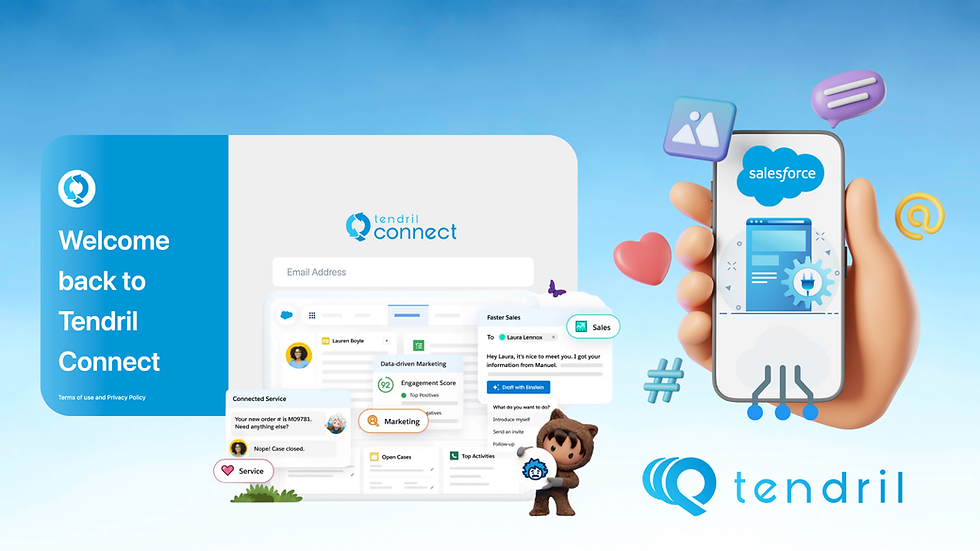
Instead of relying solely on bots, Tendril Enrich uses human researchers to verify your Salesforce data. We don't just provide a phone number; we confirm that the person is still at the company and that the number actually reaches their desk or mobile. This level of Salesforce lead enrichment ensures that when your reps use a tool like Tendril Connect, they aren't wasting time on "ghost" leads.
By cleaning your data through a human-in-the-loop process, you eliminate the friction that typically slows down outbound teams. Your CRM data becomes a verified roadmap for your sales team rather than a list of guesses.
Make Your Data a Competitive Advantage
Data enrichment should not be viewed as an administrative chore. It is a strategic investment in your team's productivity. When you prioritize data quality, you are giving your salespeople the gift of time; the time to focus on closing deals rather than researching phone numbers.
By integrating human-verified enrichment like Tendril Enrich into your Salesforce CRM, you create a foundation for success. You ensure that your Salesforce workflows are triggered by truth, not errors, and that every outbound effort is backed by the best possible intelligence.
Is your Salesforce data working for you, or against you?
Explore Tendril Enrich today and see how human-verified data can transform your sales performance and CRM accuracy.
FAQ Section
1. What is the difference between data cleaning and data enrichment?
Data cleaning is the process of removing errors, duplicates, and outdated information from your CRM. Salesforce data enrichment goes a step further by adding new, valuable information (like direct-dial numbers or industry details) to your existing records to make them more useful for sales and marketing.
2. How often should I enrich my Salesforce data?
Because B2B data changes so rapidly, we recommend a major enrichment sweep at least once a quarter. However, for high-volume outbound teams, real-time enrichment for new inbound leads is essential to maintain "speed to lead" and accuracy.
3. Does Tendril Enrich work with my existing Salesforce records?
Yes. Tendril Enrich is designed to integrate with your Salesforce CRM. You can identify the segments of your database that need verification, and our team handles the rest, updating your records with human-verified information.
4. Why is human-verified data better than AI-generated data?
AI tools are great at scale, but they often struggle with nuance—like knowing if a person has recently changed roles or if a satellite office has closed. Human verification provides a much higher "connect rate" because a real person has confirmed the details, saving your sales reps from dialing dead ends.
5. How does enriched data improve my Salesforce workflows?
Enriched data allows for more complex automation. For example, you can create a workflow that automatically sends a specific "re-engagement" sequence if a lead's company reaches a certain funding milestone or if a contact changes their job title to one of your target personas.


Comments