7 Ways Tendril Connect Salesforce Integration Maximizes Outbound Sales Performance

Updated: Jun 15

Salesforce is the system of record for most modern sales organizations. It holds account data, lead history, activity logs, and pipeline forecasts. According to IDC, Salesforce leads the global CRM market with more than 20 percent market share, and has been ranked the number one CRM provider for over a decade.
Yet even with Salesforce at the center, many teams struggle to turn CRM data into consistent outbound conversations. Reps export lists, bounce between tools, and spend too much time dialing and logging activities. The result is low connect rates, slow time to first touch, and inconsistent reporting.
Tendril Connect is designed to fix that. It integrates directly with Salesforce, uses agent-assisted outbound calling to handle the heavy work, and sends only live conversations to your reps while logging everything back into Salesforce.
Below are seven concrete ways the Tendril Connect Salesforce integration helps you maximize outbound sales performance.
1. Lift Connect Rates by Treating Salesforce Reports as Live Call Engines

Cold outreach is still hard. Various studies place average cold call conversion rates in the 2 to 5 percent range, with many teams needing double digit dials to reach a single decision maker.
Most teams feel that pain because they ask reps to do everything themselves. Reps create or export lists from Salesforce, dial each number, leave voicemails, and update call outcomes. By the time they finally reach a live person, they are exhausted or already behind on their other work.
With Tendril Connect, Salesforce reports become true outbound engines.
You build a report in Salesforce on Accounts, Contacts, or Leads. Tendril uses that report as the call list. Tendril’s team handles repeated dials, bad numbers, and phone trees. Reps only step in when there is a live conversation ready for them.
This structure improves:
Connect rate per rep hour, because your reps are not wasting time on failed attempts
Consistency of outreach, because the system works centrally from Salesforce reports
If your team already trusts Salesforce as the source of truth, Tendril Connect converts those static reports into a live stream of qualified conversations.
If your reps are stuck dialing more than they are speaking, it might be time to let an agent-assisted engine handle the front part of outbound calling and keep Salesforce as the core.
2. Increase Call Volume Without Burning Out SDRs
Most SDR productivity benchmarks show that teams need a significant number of touches to drive pipeline. In many outbound environments, it takes more than a dozen dials to reach a single prospect, and most SDRs only log a handful of real conversations each day.
That creates an obvious problem. To grow pipeline, you either:
Ask SDRs to dial far more per day, which leads to burnout, or
Hire more SDRs, which is expensive and slow
Tendril Connect offers a third option. By connecting to Salesforce and assigning call lists to Tendril’s agents, your call volume increases significantly without increasing pressure on the internal team. Outbound sessions can be scaled up or down based on campaigns, territories, and quarters.
Reps still sit inside Salesforce. They still work their Tasks and Opportunities. The difference is that they receive more live calls per hour, without having to generate all the dials themselves.
This contributes directly to:
Higher outbound volume, without proportional growth in internal headcount
More conversations per SDR, which feeds opportunities and pipeline faster
3. Improve Time to First Touch on New Leads and Segments
Speed to lead still matters. Studies show that businesses that respond to leads within five minutes are dramatically more likely to connect and convert than those that wait even half an hour or more. Some research puts that multiplier at 8 to 100 times more likely to qualify the lead when contact happens quickly.
Salesforce is excellent at capturing new leads. The challenge is reaching out quickly and consistently, particularly when inbound volume spikes or when the same reps are balancing outbound and existing pipeline.
With Tendril Connect integrated into Salesforce, new lead flows can be turned into outbound calling programs very quickly:
A RevOps or Sales Ops owner builds a Salesforce report that filters new leads by age, source, or score
Tendril uses that report to prioritize outbound sessions
Tendril agents work through the list and warm-transfer interested leads to reps or book meetings, while logging outcomes as Tasks
This model shortens time to first touch, particularly for new segments, new territories, or high-intent leads that deserve rapid follow up.
If response time to new leads in Salesforce is measured in hours or days instead of minutes, an integrated outbound partner like Tendril Connect can close that gap without requiring you to rewire your internal team.
4. Strengthen Salesforce Data Quality Through Automatic Call Logging

Reporting accuracy lives or dies on data quality. When reps log calls manually, outcomes and dispositions are often inconsistent. Some calls never get logged at all. That erodes the power of Salesforce dashboards and complicates conversations about performance.
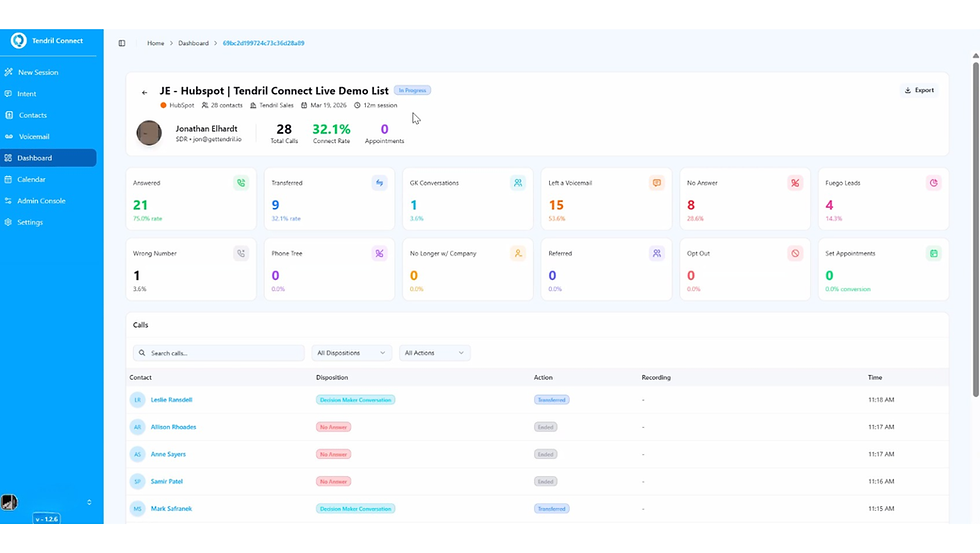
With Tendril Connect, every completed outbound call is written back to Salesforce as a Task. Key fields such as outcome, related Account or Contact, timestamps, and notes are standardized as part of the process.
This matters to:
RevOps and Sales Ops, who need clean data for dashboards and forecasting
Sales leaders, who want to compare campaigns, segments, or territories with confidence
Founders and revenue leaders, who rely on Salesforce as the single source of truth
Because Tendril respects your existing Salesforce permissions and sharing rules, the integration improves data quality without sacrificing governance or control.
5. Accelerate Pipeline by Focusing Reps on High-Value Conversations
Cold calling still works, but it works best when it leads to real conversations. Recent research shows that a large percentage of B2B buyers are still willing to take meetings from cold outreach, and phone remains one of the preferred initial contact channels.
The bottleneck is not buyer interest. It is rep bandwidth.
When reps are busy dialing, they have less energy and time left to run discovery, tailor their pitch, or move deals forward. Tendril Connect protects rep time by removing much of the low-value activity and leaving them with the part that actually moves pipeline: live, qualified conversations with decision makers.
That focus supports:
Higher opportunity creation rates, because more calls are actual conversations
Shorter cycles from first touch to scheduled meeting, because reps engage when prospects are already live and engaged
Better use of senior sellers, who can step into warm conversations without grinding through cold lists
If your Salesforce reports show many activities but relatively few real conversations, shifting to an agent-assisted outbound model can unlock more meaningful pipeline from the same CRM data.
6. Give SDRs Better Tools While Keeping Salesforce as Home Base

Teams often try to fix outbound performance by adding more tools on top of Salesforce. A dialer here, a sequencing tool there, plus several tabs open for research. Over time, this makes SDR work fragmented and hard to manage.
Tendril Connect takes a different path. Instead of asking SDRs to juggle another interface, the integration keeps Salesforce as the central workspace:
Lists are Salesforce reports
Activity history is Salesforce Tasks
Pipeline insights live in Salesforce dashboards
Tendril sits behind the scenes as a specialized outbound calling layer, not as a competing CRM. SDRs and AEs focus on what they see inside Salesforce, while Tendril handles the engine work of dialing and routing.
This gives you the benefit of a high-powered outbound tool, while limiting cognitive load and preserving the familiar Salesforce experience.
7. Make Outbound More Predictable With Clear Metrics and Benchmarks

High performing outbound teams treat their dialing and connect rates like a real system, not just a daily grind. They track dials, connects, meetings, and pipeline created. Public benchmarks suggest that many SDR teams book around fifteen meetings per month, and average only a few quality conversations per day.
Tendril Connect helps you create a more predictable system for outbound inside Salesforce:
Inputs are clearly defined via Salesforce reports
Outputs are captured as standardized Tasks with outcomes
Leaders can slice performance by segment, campaign, territory, or rep
Because Tendril is built to operate at consistent volume, you can design outbound programs with clearer expectations. For example, you might set goals around:
Number of accounts swept per quarter
Connect rates by segment
Meetings created per Tendril session
Pipeline generated from specific Salesforce reports
This helps revenue leaders move from gut feel to data-backed outbound planning.
If you want outbound to look and feel more like an engineered system and less like a daily scramble, connecting Tendril directly to Salesforce is a straightforward way to get there.
Get Tendril Connect Inside Your Salesforce Environment
If you already rely on Salesforce to run your pipeline, you are sitting on a powerful dataset that can generate many more conversations than your reps can reach on their own.
The Tendril Connect Salesforce integration will help you:
Turn static Salesforce reports into live outbound call engines
Increase connect rates and outbound volume without burning out your SDRs
Keep every call outcome logged in Salesforce for accurate reporting and forecasting
If you want to see how this could work in your environment, schedule a Tendril Connect for Salesforce demo and walk through a real integration example.
You will see how existing reports can become high performing outbound programs, without changing how your team already uses Salesforce.

FAQs: Tendril Connect and Outbound Calling in Salesforce
1- How does Tendril Connect integrate with Salesforce?Tendril Connect integrates through a secure OAuth connection. A Salesforce admin authorizes Tendril, and the integration then uses Salesforce reports as call lists. Completed calls are logged as Tasks in Salesforce, including outcomes, timestamps, and related records.
2- Does Tendril Connect replace my Salesforce dialer or CTI?Tendril does not have to replace your CTI or dialer. Instead, it sits beside those tools. CTI can remain useful for individual calls, while Tendril handles high-volume outbound sessions where an agent-assisted model makes more sense.
3- How does Tendril improve connect rates and SDR productivity?Tendril improves connect rates by handling repeated dials, bad numbers, and phone trees before a rep ever gets involved. SDRs and AEs then spend more time in live conversations and less time on unsuccessful attempts, which increases the number of productive interactions per hour.
4- Will my Salesforce data stay accurate and secure?Yes. Tendril respects existing permission sets and sharing rules, and writes completed calls as standardized Tasks. This improves the completeness and consistency of your Salesforce data while keeping your security and governance model intact.
5- Who gets the most value from Tendril Connect for Salesforce?
Teams with an established Salesforce instance, active outbound or hybrid motions, and a need to scale conversations rather than just dials tend to benefit most. This includes SDR teams, sales teams doing outbound from Salesforce, and RevOps organizations that want cleaner metrics without expanding headcount.


This is such a well-written article! It’s very useful for students searching for professional salesforce classes in pune.